AI-Powered Job Search & Interview Prep
The 4-phase methodology behind Facet — the open-source career platform built from this exact process. Build a deep model of who you are professionally, research the right targets, prepare reusable artifacts, and tailor for each opportunity. Each phase's output feeds the next, building compound context that makes every downstream artifact sharper.
Why This Exists
Structured context beats raw intelligence
Most engineers approach interview prep the same way: review their resume, practice LeetCode, Google some behavioral questions. The problem isn't effort. It's structure. You get generic preparation for specific situations.
I took a different approach: a 4-phase pipeline where each step's output feeds the next, building compound context that makes every downstream artifact sharper. This page documents the methodology. Facet is the open-source product built from it.
Pipeline Architecture
↓
Archetype 2-3 Angles Strength/Gap Analysis
archetype + angles + gaps ↓
Deep Research Interview Formats Stack Overlap
20+ targets + formats ↓
Variant Scripts Deep Dives Interactive Prep Page
reusable prep artifacts ↓
Fit Map Gap Framing Company-Specific Tips
↓
🎯 Interview Ready
The core insight
An AI with your resume can give you generic interview advice. An AI with your resume, technical documentation, candidate profile, market research, and gap analysis can give you a prepared answer for the exact question a specific company is likely to ask about the exact gap in your profile for their exact role.
The compound context is the product. Each phase builds on the last.
Phase 1
Candidate Profiling
Before you can prepare for interviews, you need to understand what you're selling. Most engineers skip this and jump to "help me prep," which is why they get generic advice.
Resume, technical references, architecture decision records, project docs, design docs. The more context, the sharper the output. I provided ~170 pages of technical references across four platforms. The technical docs were the highest-signal input. They contained architecture decisions, performance benchmarks, and tradeoff discussions that a resume can't capture.
Not your title. The pattern of how you work. Mine came back as "Builder": the engineer who gets dropped into a situation where something needs to exist and doesn't, then ships it end-to-end. That pattern held across both companies. It's a more useful framing than "Senior Platform Engineer" because it tells a story about how I operate, not just what my title was.
Different ways to frame the same experience depending on who you're talking to.
| Angle | Headline | Best For |
|---|
| Security Platform | "I build security infrastructure: edge sensors, fleet management, threat intelligence" | WAF/AppSec, security startups, detection engineering |
| Platform / DevEx | "I treat infrastructure as a product: build systems, developer tooling, self-service platforms" | DevTools, IDP, observability, platform teams |
| SRE / Infrastructure | "I find the bottleneck, build the system that removes it, then hand it off" | Infrastructure, reliability, cloud platforms |
Output
Archetype identification
Output
2-3 positioning angles
Output
Strength/gap analysis with gap framings
Phase 2
Market Research
Identify target companies where your profile has a genuine competitive advantage. Not just companies that are hiring, but companies whose interview process and culture reward what you specifically bring.
Pass 1: Builder-friendly interviews. Companies with take-home assessments, paid work trials, portfolio reviews. If your strength is demonstrable output, optimize for formats that let you demonstrate it.
Pass 2: Stack and domain overlap. Companies where your specific technical experience maps directly to their product or infrastructure.
For each target: specific open roles, documented interview process, AI culture signals, stack overlap analysis, competitive advantage narrative, compensation range, and application tips specific to their process. The research identified 20+ targets ranked by signal convergence — not just "who's hiring" but "where does my profile win."
Output
20+ ranked target companies
Output
Interview format analysis per company
Output
Competitive advantage narratives
Phase 3
General Study Guide
Build a reusable preparation artifact. Something you can open 10 minutes before any interview and quickly navigate to the relevant talking points. This is the 80% that's company-agnostic.
"Tell me about yourself" has three versions (Platform, Security, and Builder), each leading with different experience and tuned to different company types. You pick the variant based on who you're talking to. Each script is annotated with a "Best for" callout naming specific companies from the research.
Built as an interactive web page: grid of clickable tiles, floating header nav, modal system, keyboard shortcuts. Click a tile, get the modal with your talking points, arrow-key to the next section. 25+ sections covering openers, project deep dives, behavioral variants, and a key numbers reference. Designed for the literal moment you're sitting in a waiting room.
Grid Layout Modal System Variant Tabs Keyboard Nav Floating Header
Output
Interactive study guide (HTML)
Output
Variant scripts per angle × question
Output
Project deep dives + key numbers
Phase 4
Per-Listing Analysis
For each specific job listing, produce a targeted analysis: how your profile maps to their requirements, where you're strong, where you're thin, and how to talk about the thin spots. The 20% that's company-specific, but the highest-signal 20%.
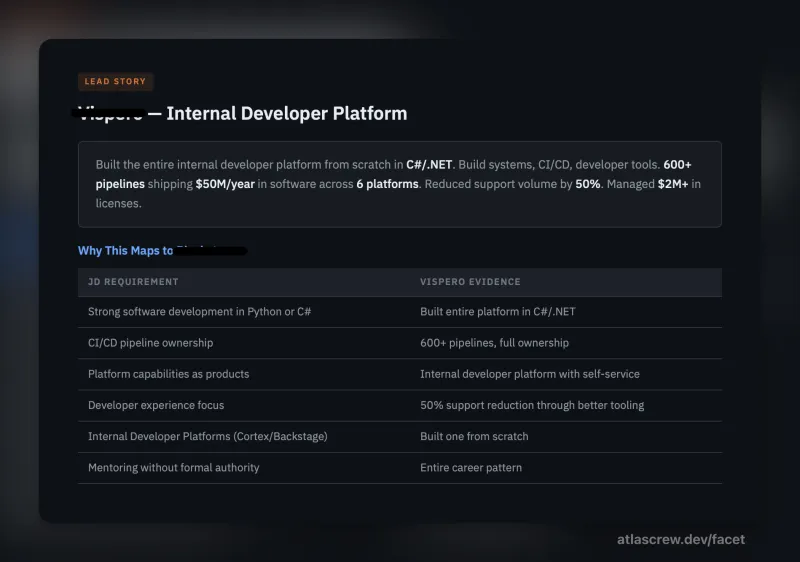
Map each stated requirement to your actual experience. For each: the requirement, your relevant evidence, fit level (Strong / Partial / Gap), and if it's a gap, prepared framing that's honest but redirects to adjacent strength. "You don't have Go, here's how to handle it" is more useful than pretending the gap doesn't exist.
Likely questions based on the gaps in your profile for this specific role. Interview tips tailored to their known process: take-home strategy, pair programming approach, system design framing. Company hooks: specific things to mention that show you've done homework on this company. Not "I like your mission." Specific technical decisions they've made that you have an informed opinion on.
Output
Fit map with gap framings
Output
Predicted hard questions + answers
Output
Company-specific cheat sheet
From Methodology to Product
The methodology became Facet
I ran this 4-phase process by hand, in a Claude Project, with markdown files and an interactive HTML study guide. It worked. Then I built it as a product so anyone could run the same loop without the manual setup.
Facet is the open-source platform that turns this methodology into a daily workflow. Each phase of the manual process maps to a workspace in the app. The compound context that made the manual process work — resume, technical docs, candidate profile, market research, gap analysis — gets persisted, structured, and re-used across every opportunity.
The phases didn't disappear. They became the product surface.
From Phase 1 — Profiling
Build
Resume engine with vector-based targeting. Per-bullet include/exclude, skill group routing, Typst WASM PDF rendering with 8 themes. Your archetype and angles become reusable vectors you target at each opportunity.
From Phase 2 — Research
Research
AI infers a search profile from your resume, runs targeted searches with vector priorities, and pushes results into Pipeline. Skips companies you've already rejected. The 20+ ranked targets become an ongoing pipeline, not a one-time list.
From Phase 2 — Tracking
Pipeline
Full job tracking. Company, role, URL, comp, status, JD storage, vector linkage, activity history. The market research artifact becomes a living system that hands off into Build, Prep, and Letters.
From Phase 3 — Study Guide
Prep
Interview prep decks linked to pipeline entries. AI generates cards from the JD, your resume, and company research. Search, filter, edit, practice mode for rehearsal. The static HTML study guide becomes per-opportunity dynamic decks.
From Phase 4 — Per-Listing
Letters
Template-based cover letters with paragraph-level vector controls. AI drafts from pipeline context — opportunity, vector, company research, assembled resume data. The per-listing analysis becomes the input to a draft you can ship.
Cross-cutting
Persistence & Backup
Encrypted workspace backups with passphrase-based WebCrypto. File System Access for native save/load. The compound context survives across sessions — no more re-uploading 170 pages of docs to a fresh chat.
Why open source
The methodology works because the compound context is yours. Your resume, your tech docs, your interview history, your profile. None of that should live on someone else's server unless you choose to put it there.
Facet is AGPL-licensed and self-hostable. Bring your own AI keys (OpenAI, Anthropic, others). The free tier covers everything except the AI workspaces — and the AI workspaces work right now in self-hosted mode.
Resources
Downloads
Standalone tools from the Facet methodology. Use these in a Claude Project or on their own — no Facet account needed.
Screenshots
What you get. Click any thumbnail to expand.
Resume Builder
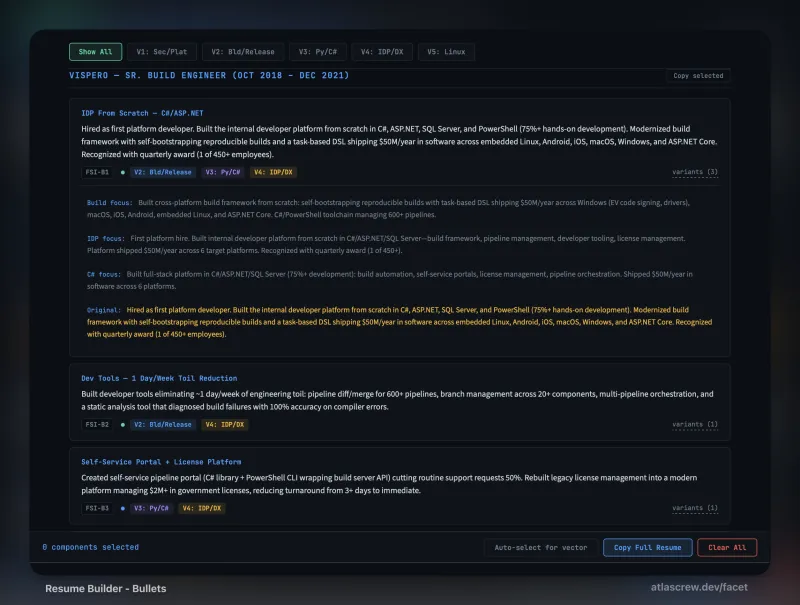
Vectors
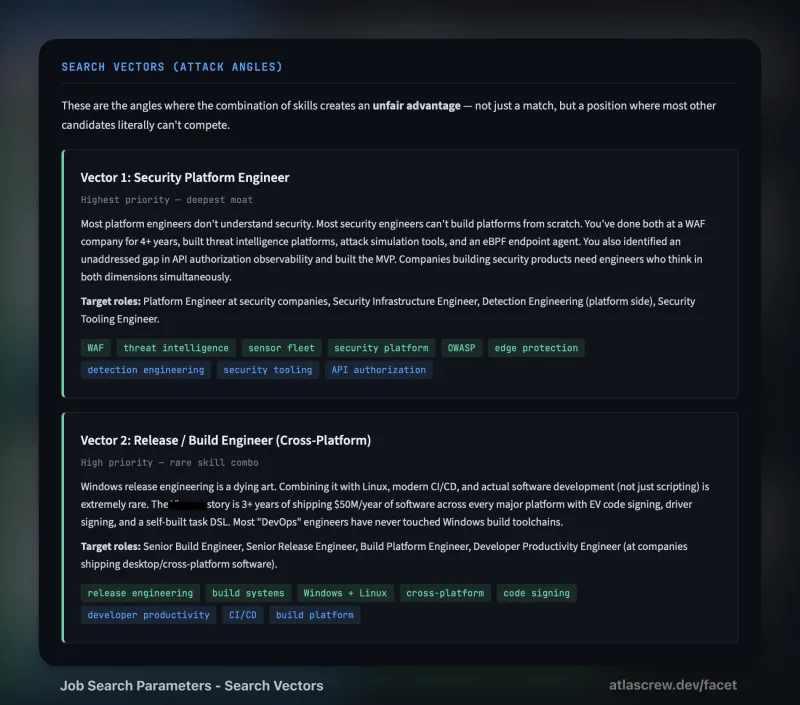
Bullets
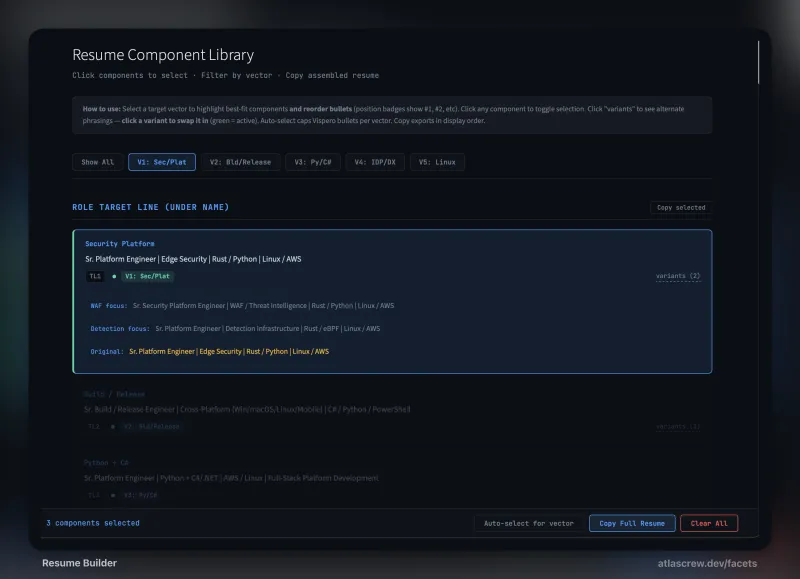
Targets
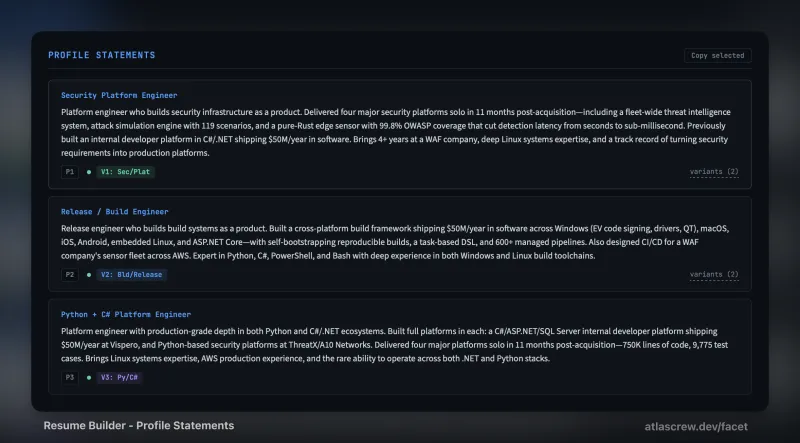
Profiles
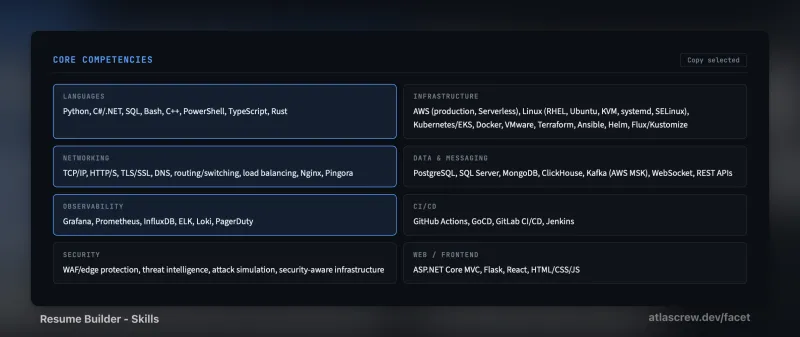
Skills
Search Parameters
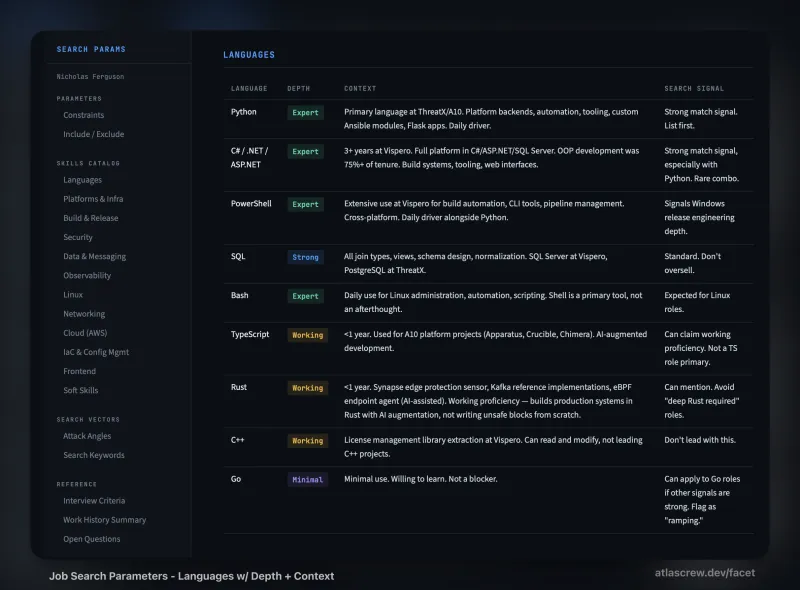
Languages
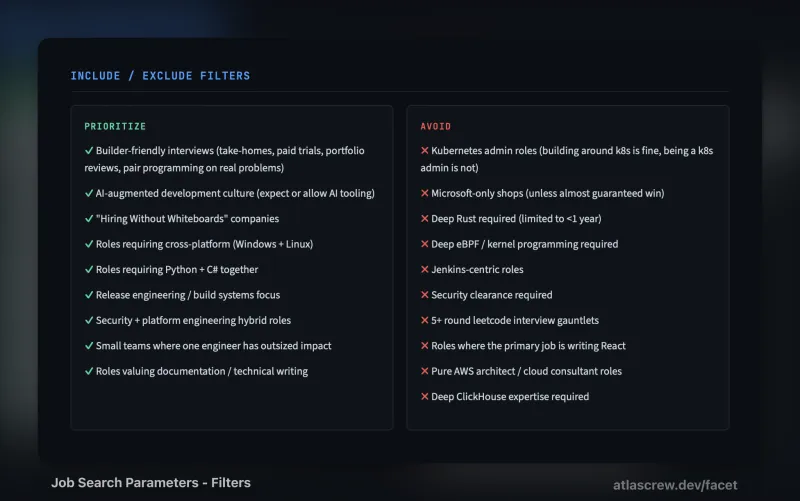
Filters
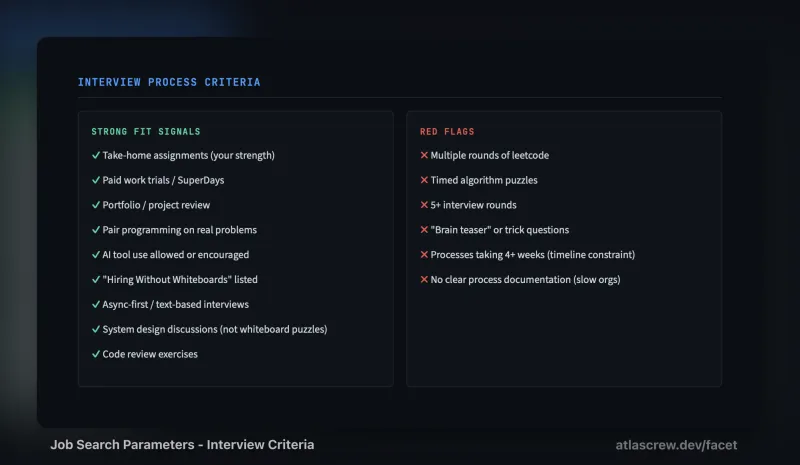
Preferences
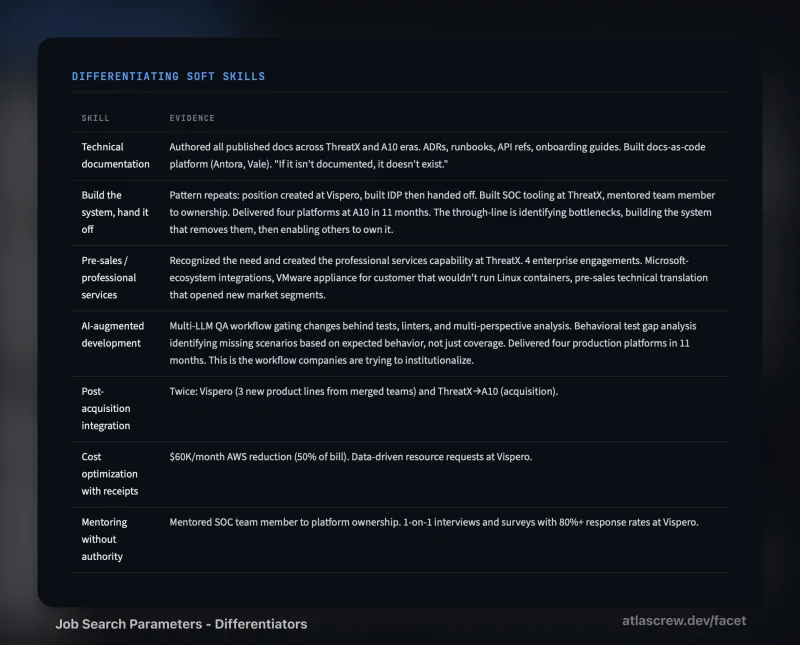
Differentiators
Pipeline Tracker
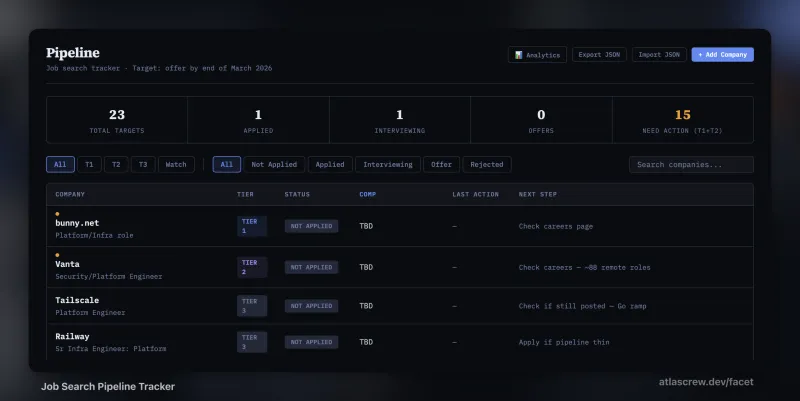
List View
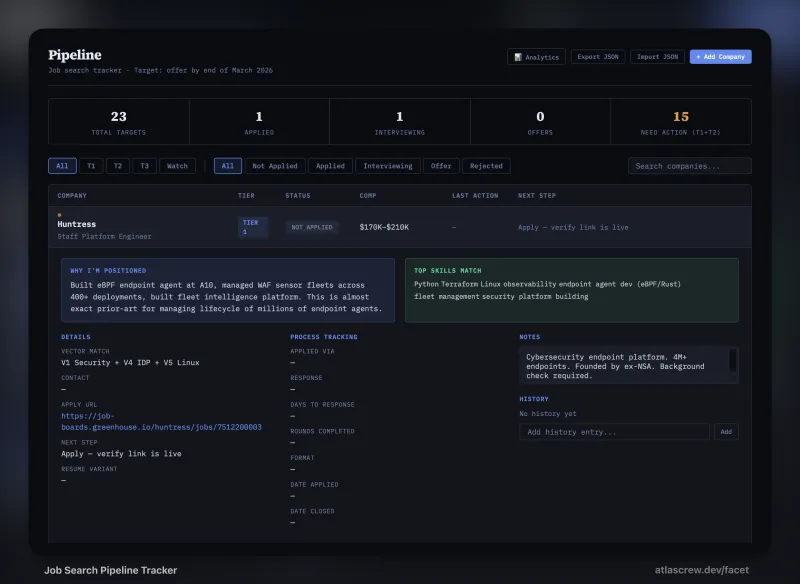
Details
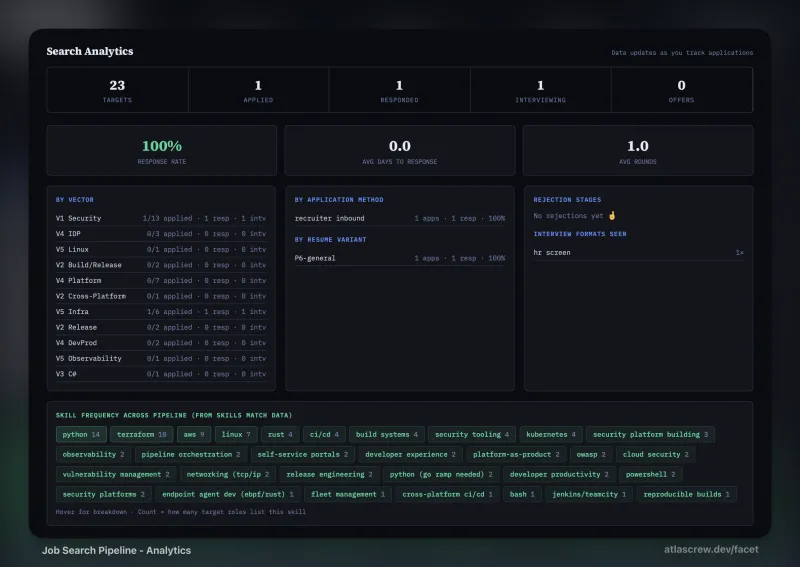
Analytics
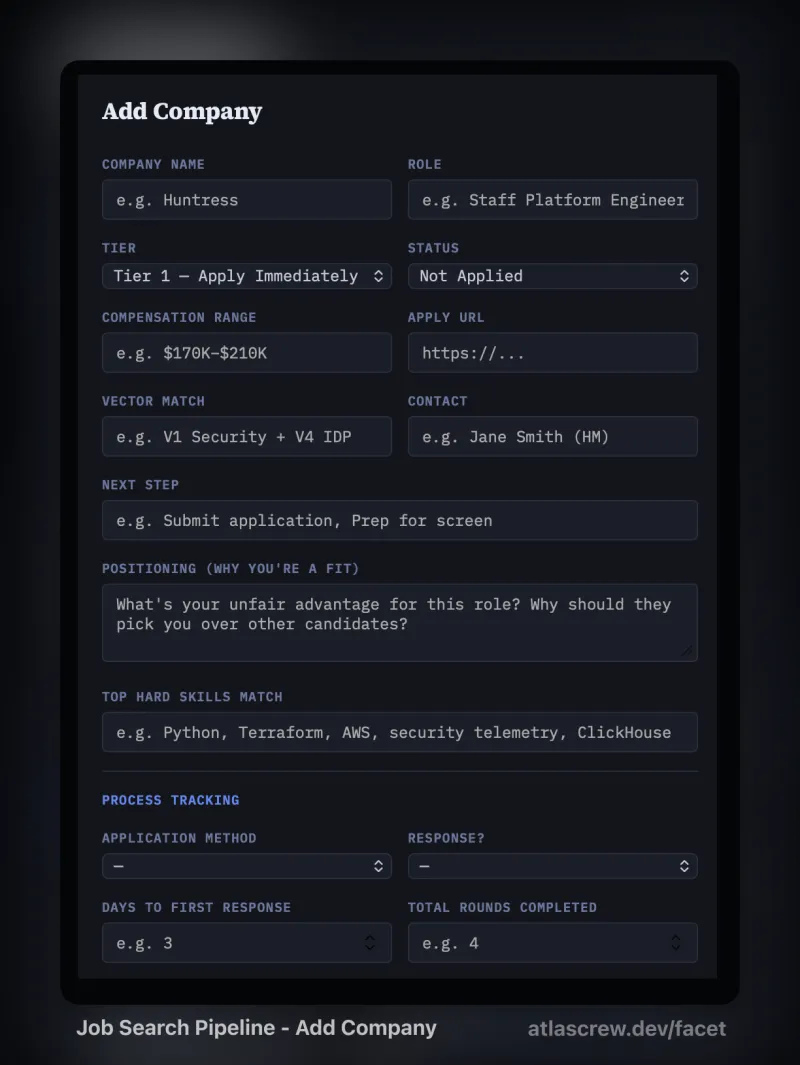
Add Company
Interview Prep
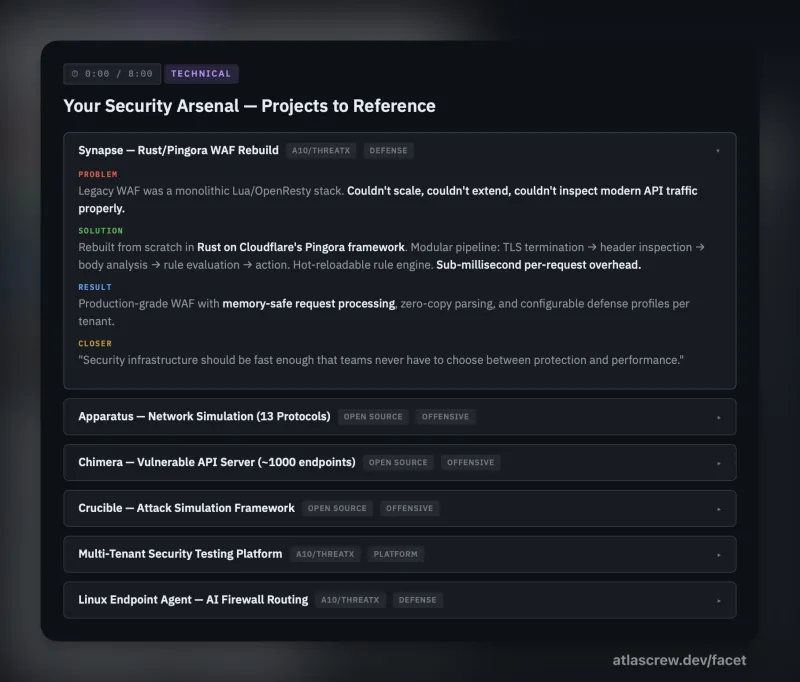
Projects
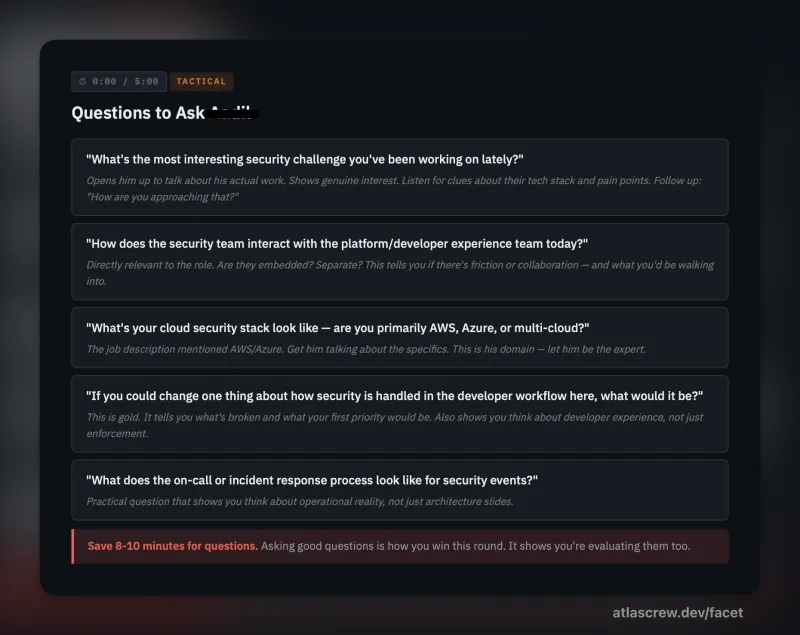
Questions
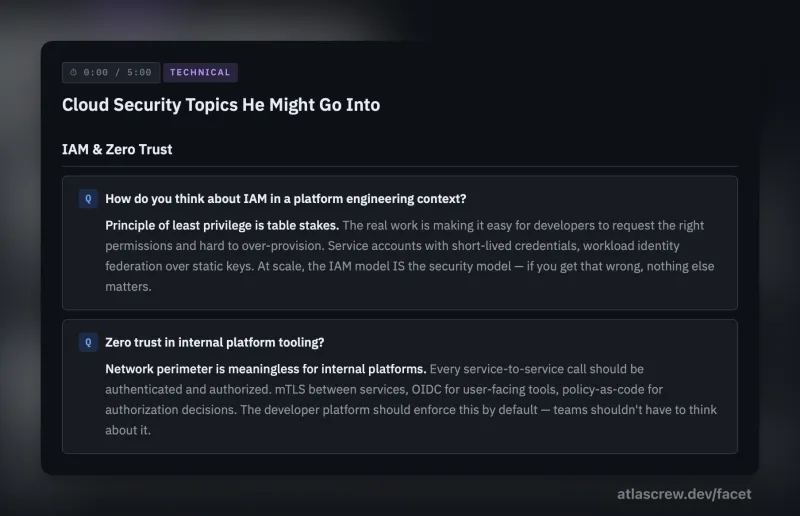
Topics
Experience
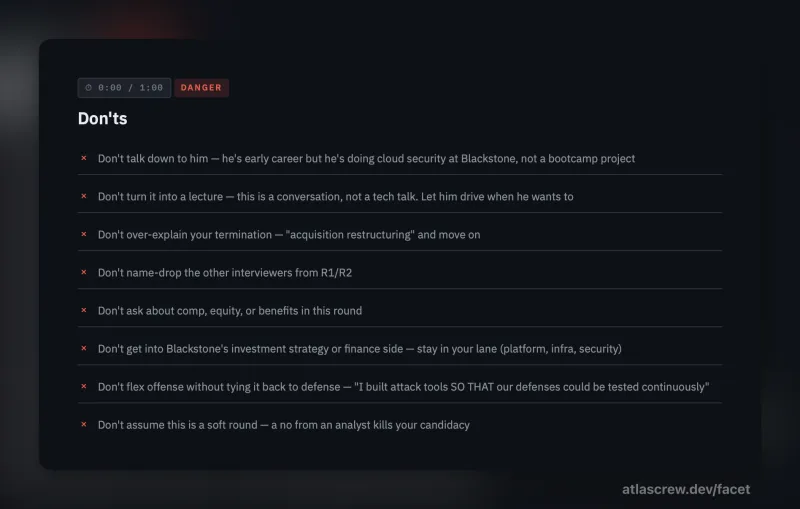
Don't's